October 22nd 2025
Dr Michael Jones
Mistletoe, fact, myth and legend was exactly what we were given by Dr Michael Jones, a popular returning speaker. Dr Jones was a lecturer in Botany at Newman University in Birmingham as well as spending three years in Africa studying Mistletoe. He continues to visit Africa each year to study the pollination of these plants.
Our talk was initially about the botany of Mistletoe and we learnt that there are two families of Mistletoe; 940 species of Loranthaceae (the showy ones) and 450 species of Viscaceae, 1390 in total. Recorded species include the smallest, which has berries larger than the plant itself, and the largest in Western Australia which looks like a tree.
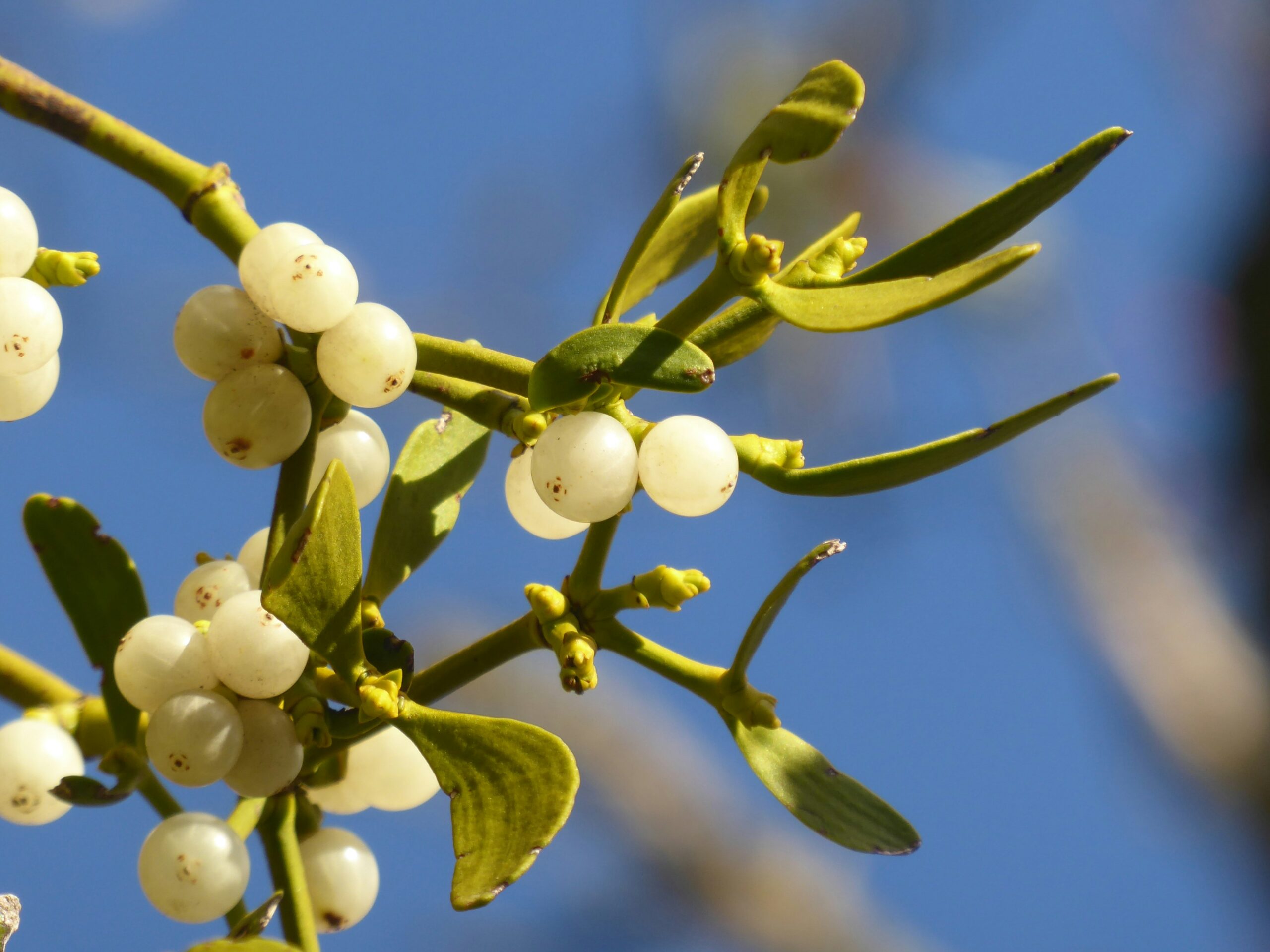
The term Haustoriam was introduced next. A projection from the parasitic Mistletoe that anchors it to the host and then enables the Mistletoe to penetrate host tissues and absorb nutrients. The host is not killed but does suffer.
One thing that surprised many of us was that the Mistletoe we commonly associate with Christmas in the UK, namely Viscus album, grows only in the south of England, particularly around counties like Worcestershire and Herefordshire. Whilst happy with cold winters it likes an average July temperature of 16 degrees. Seeds are dispersed by the aptly named Mistletoe Thrush but also Blackcaps.
We learnt the ball shape (usually seen in apple trees) is formed through annual dichotomous branching and this allows the plant to gain maximum exposure to sun.
December 1st is National Mistletoe Day and in Tenbury Wells, the Mistletoe capital of England, various traditions take place.
Using Mistletoe is thought to originate from Saturnalia an ancient mid winter Roman festival, later becoming Christmas, when not much was available to decorate. Why do we kiss under the Mistletoe at Christmas? No one really knows but there are lots of associations of love and friendship, fertility and life due to fruiting in our winter and this English tradition became more popular under the Victorians.
Druids revered Mistletoe on oak trees and saw it as a cure all leading to All Heals Day (now All Hallows Day). Medicinal uses for Mistletoe include a complementary treatment for cancer and use as an anti inflammatory. However, Mistletoe is extremely toxic in high doses and contains Viscin, similar to Rycin which was used to kill the Russian Dissident in 1978. It is therefore mentioned in the Prevention and Suppression of Terrorism Act.
So overall we learnt much about Mistletoe but also how much is still yet to be learnt and through questions Dr Jones suggested there were many PHD topics still to be explored.