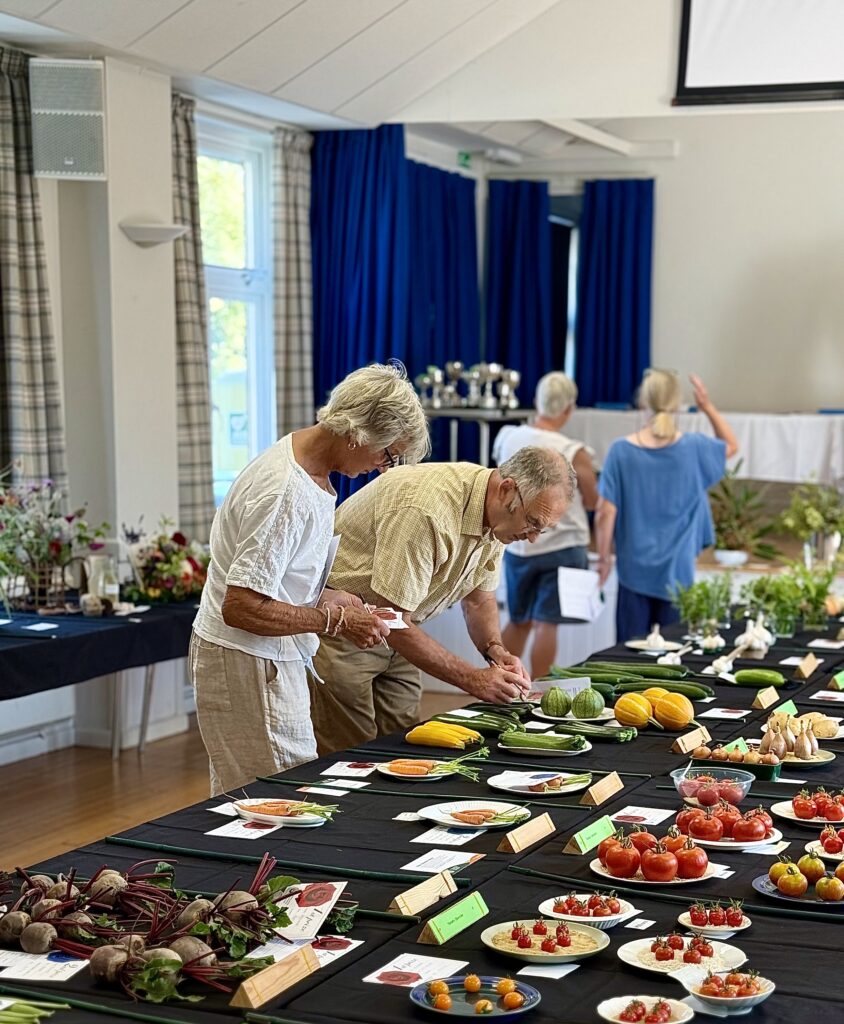
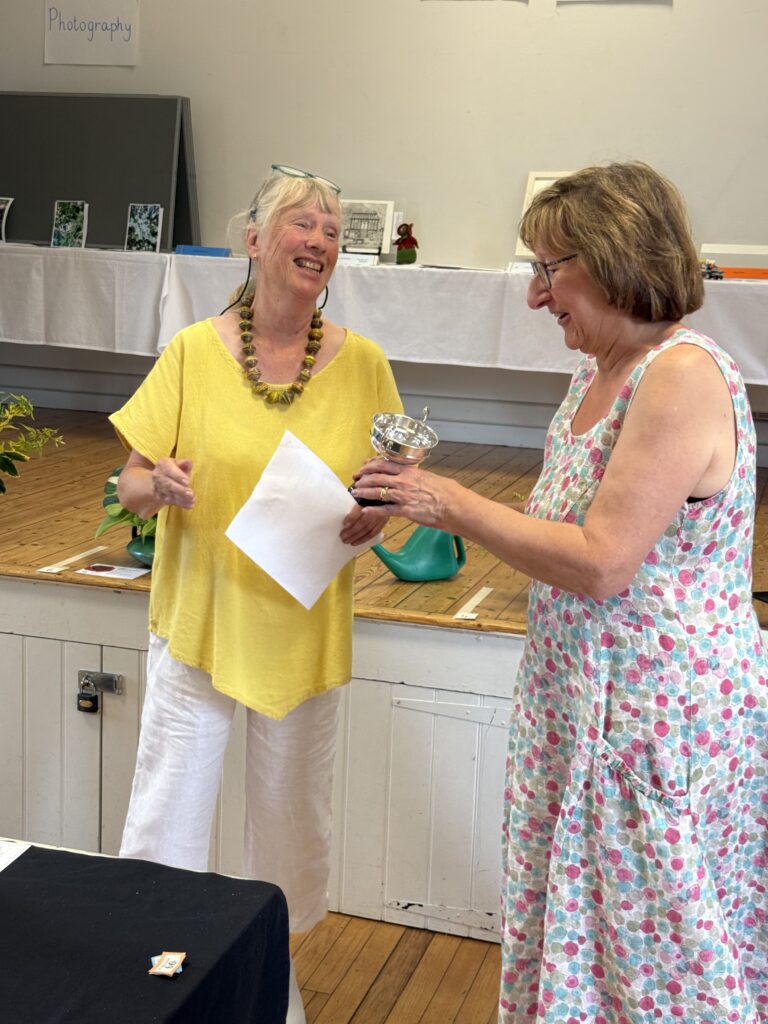
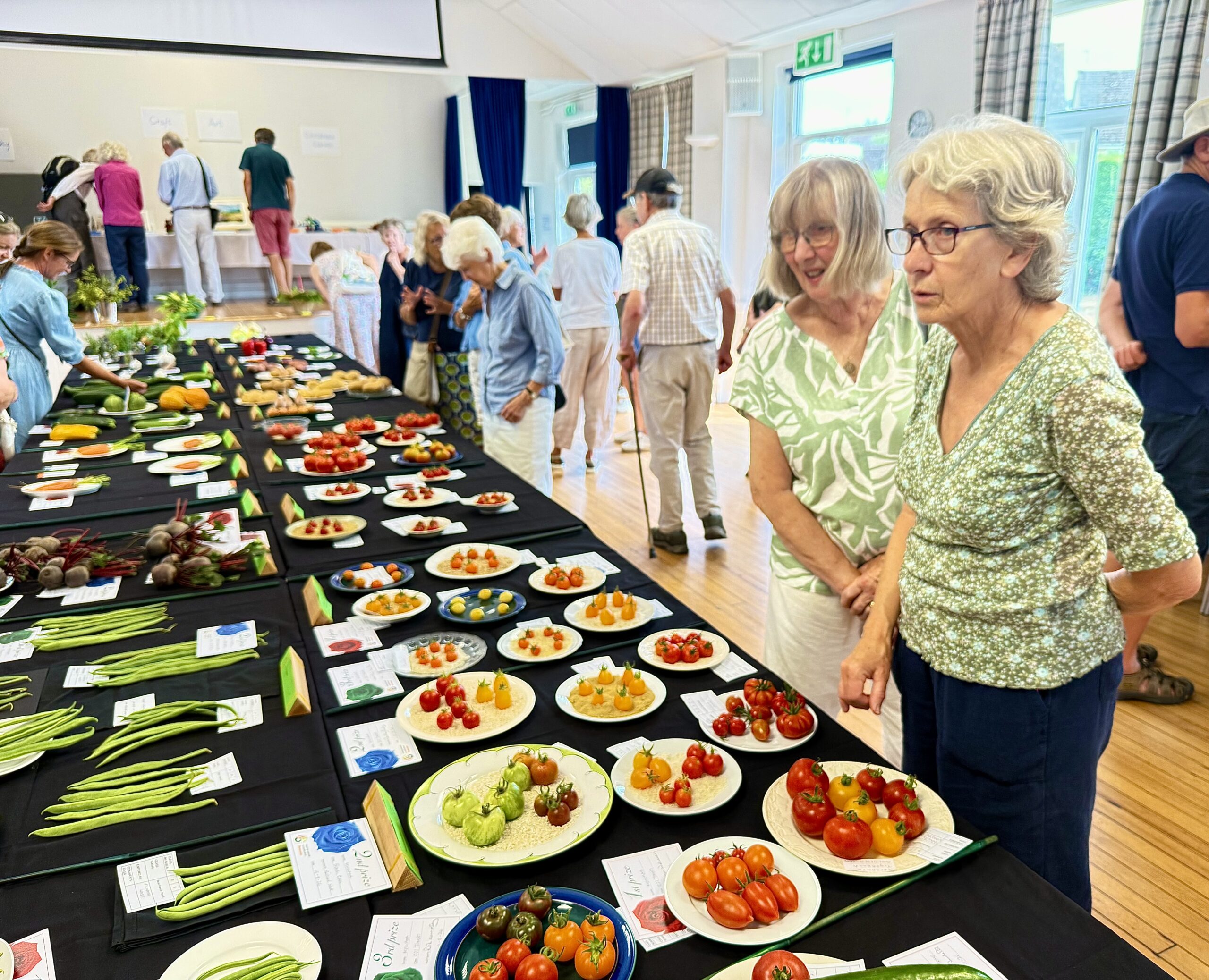
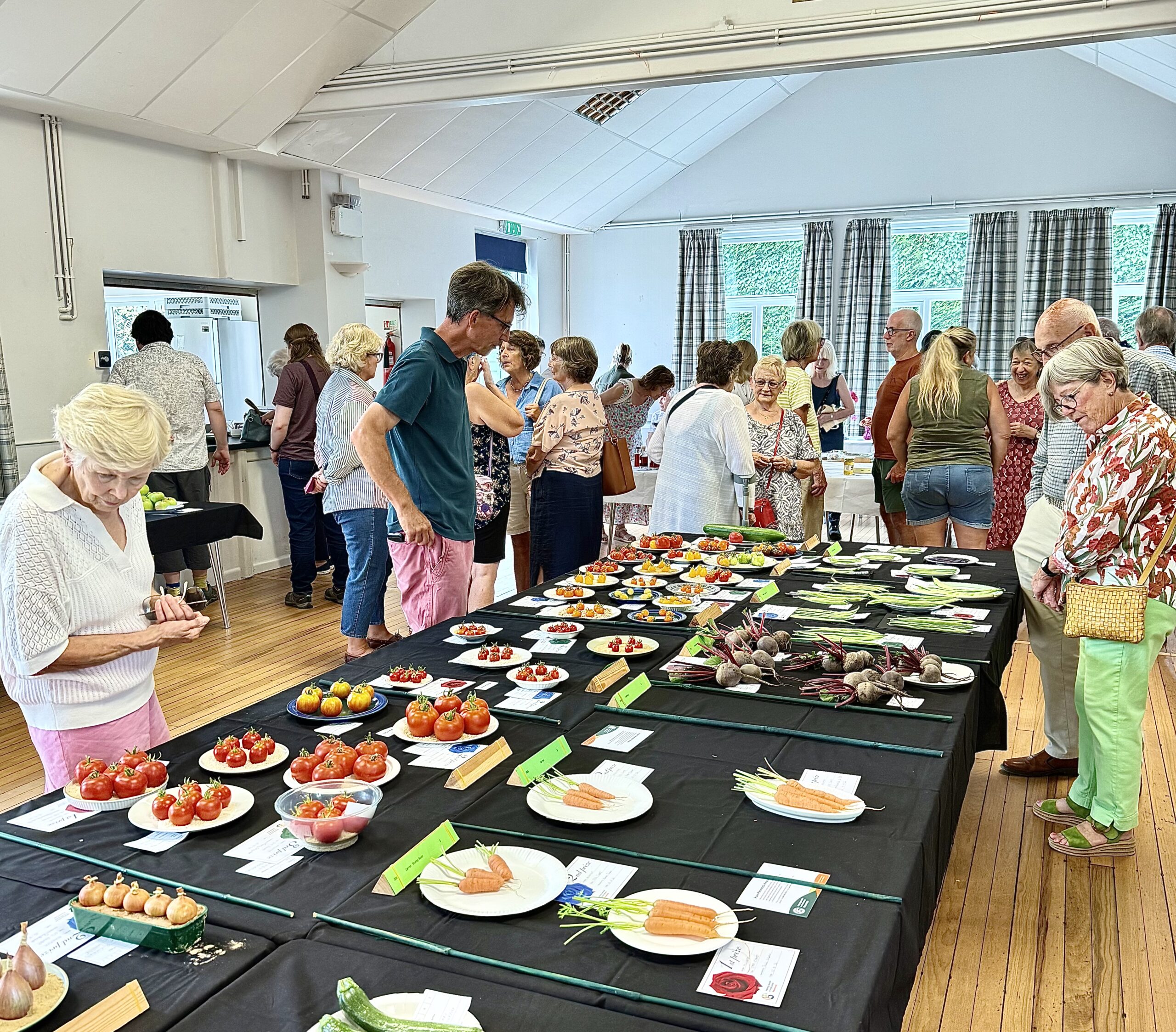
After such high temperatures and no rainfall we all wondered what sort of Show we would have .
Then we realised that we had quite a few classes that were not weather dependent at all – craft, cookery and flower arranging .
On the day we were amazed that vegetables and flowers came in through the door as well. The judges commented on the high standards considering other local shows have been cancelled.
We had a record number of entries, a number of first time entrants and a really good display for over a hundred visitors in the afternoon to look at.
Tea and cake were as popular as ever as was the grand raffle . We have already fixed the date for 2027 and booked the Hall so start planning and we hope to see you there .
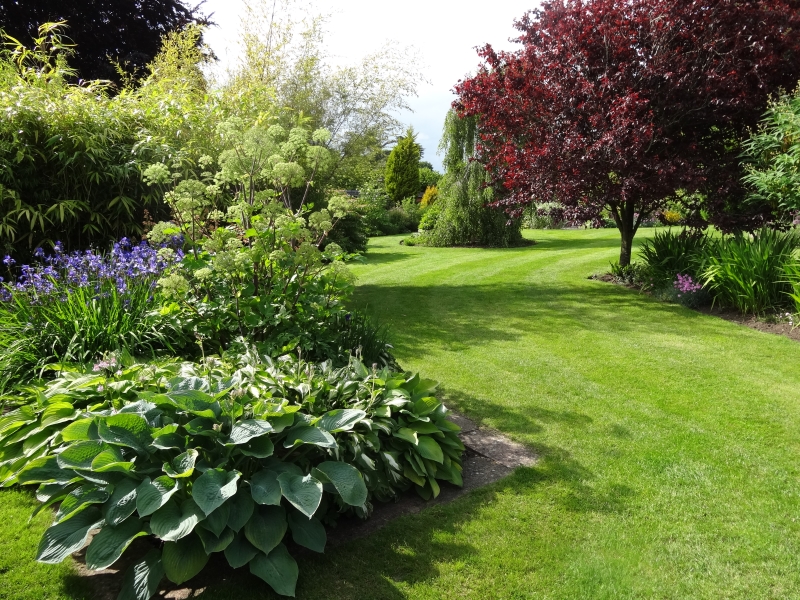
Our final talk of the season attracted one of our largest audiences of members and guests. Our Chair Nicky Pratt needed little introduction to talk about her garden at the end of Bruern Road. She moved there thirteen years ago to find half an acre of lawns, old fruit trees and a few shrubs. Since then with great vision a transformation has been achieved and it continues to change and to delight. Her love of gardening shone through with every word along with her expertise and enthusiasm. We were entranced and envious of her passion and energy.
The accompanying photographs , taken throughout the year, many by Alan Vickers, another MUWAGA member, enhanced the talk further and the hour sped by .
The garden has been designed with views from the windows of the house at the forefront of Nicky’s and husband John’s thinking. However, important features of relaxation have not been neglected -seating areas under trees, a hammock on the lawn and a large outside dining space with table and chairs .
We had a tour starting on the terrace ( with pots) and moving around via the different beds, aptly named top, middle and bottom bed. Mainly a cottage garden we recognised some old favourites – the salvia, the nigella, roses, clematis and foxgloves. Only small grasses are used so that they don’t dominate .Lilies grow well in pots so are placed in the borders and a dahlia fills every gap . Some more unusual things caught our eye and our imagination – a plant called sillybum and another called kiss me over the garden gate! There is one spectacular tree , a Pyrus Salicifolia. We glimpsed the vegetable bed , growing such delicacies as asparagus and strawberries and separated by 5 large oak posts , to catch the eye from the kitchen window. We saw herbs growing in a collection of galvanised troughs and containers, the greenhouse full of peppers and tomatoes in quad pots , the conservatory, home in the winter to more tender and exotic species, the orchard, the fruit cage, the shade bed and the polytunnels/cold frames for hardening off plants before planting out . The shed, compost area and pot store featured in the tour as well.
Our March talk was well attended and enjoyed by all. Val Bourne is a well known and award-winning garden writer. She judges RHS floral and dahlia trials at Wisley and lectures widely. Val is a local, gardening organically at her home Spring Cottage in Cold Aston.
She told us she got into gardening through her grandmother and first fell in love with dahlias in the fifties when their vivid colours brightened a dull era. Mostly grown to exhibit at shows they were deeply unfashionable as garden plants in the sixties and seventies. About twenty years ago they were popularised by Sarah Raven and there are now a huge number of varieties.
At the RHS trials Val judges dahlias as garden plants and not from the exhibitor’s point of view as the good ones are given the Award of Garden Merit.
There is a large genetic pool of dahlias with 35 frost tender species. They are octoploids originally from Central America especially Mexico. They are high altitude plants and like evenly balanced nights and days and an ambient temperature of 70o F.
In 1570 Spain sent out plant hunters to search for useful food plants. At first the dahlia tubers were cooked following the success of potatoes. Unfortunately, they proved inedible! In 1789 some tubers were sent to the Botanic Garden in Madrid from where Lady Bute the wife of the British ambassador to Spain acquired some. By 1802 the Empress Josephine of France had a large collection.
Originally known as Georginas they were renamed Dahlias by Linnaeus after one of his pupils. Doubles and fancies were available by 1816 and thirteen classifications had appeared by the nineteenth century. In 1836 the RHS dahlia registry began.Initially they were only grown by the elite.
Val advised leaving a generous space in the garden around dahlias as they don’t enjoy being closely surrounded by other plants. Don’t plant them in the garden until June as cold nights inhibit growth. If a plant is not producing many tubers keep it in a small pot where it will feel stressed and produce more tubers. Very large tuber masses produce less flowers so try to divide them.
If you leave tubers in the ground over winter, cold weather can kill them. Lift them after the first frost. Val does not wash hers and only drains them upside down if they are very wet. She stores them in old compost in a tray in a heated greenhouse but any frost-free place like a garage will do. If it is really cold, protect with bubble wrap.
Dahlias do well in containers but don’t place them in a very hot position. Do not feed or they will only produce foliage. Start tubers into growth in March/April in large pots using John Innes No 2 in an unheated greenhouse. Pinch out the growing tips to bush out the plant. Gradually acclimatise plants before planting outside and water well until they are established. Cuttings can be taken including a small piece of the tuber or just stem cuttings leaving a small piece in situ to grow on again.
The following plant firms are recommended
Halls of Heddon
Riverside Bulbs
Peter Nyssen
Rose Cottage Plants
Some of the best places to see dahlias in a garden situation are Wollerton Old Hall, Great Dixter and Dyffryn.
Our next speaker meeting promises to offer advice on all things Dahlia . There are 57,000 registered cultivars recognised by the RHS. Which to choose? Can you have too many? Do you lift them or leave them in the ground?
Val Bourne has been gardening for most of her life, currently at Spring Cottage in Cold Aston near Cheltenham. She is an award winning garden writer, organic gardener and lecturer and we look forward to welcoming her.
The meeting will be in Milton under Wychwood Village Hall at 7.30pm on Wednesday March 25 ( refreshments from 7pm)
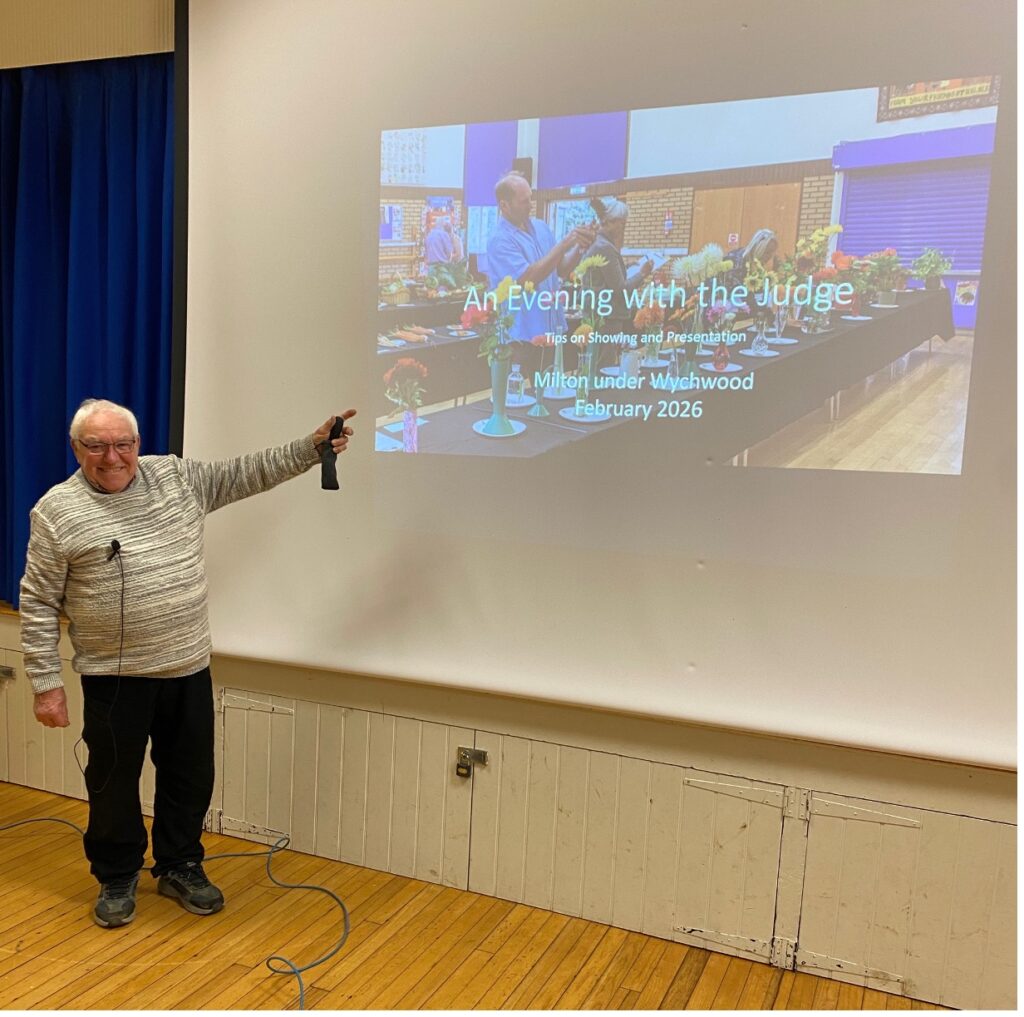
For our first lecture of 2026 we welcomed Chris Small, the Chair of the Gloucester Federation of Gardening Societies Guild of Judges. The aim of Chris’s presentation was to inform members about growing, storing and preparing fruit, vegetable and flower exhibits for competitive shows and guide us regarding how those exhibits are judged.
Chris had prepared a very useful list of tips and referred to it throughout. He tailored his talk to our 2026 Show Schedule and drew on his 25 years of judging experience to share amusing anecdotes and slides of prizewinning produce whilst encouraging members’ questions.
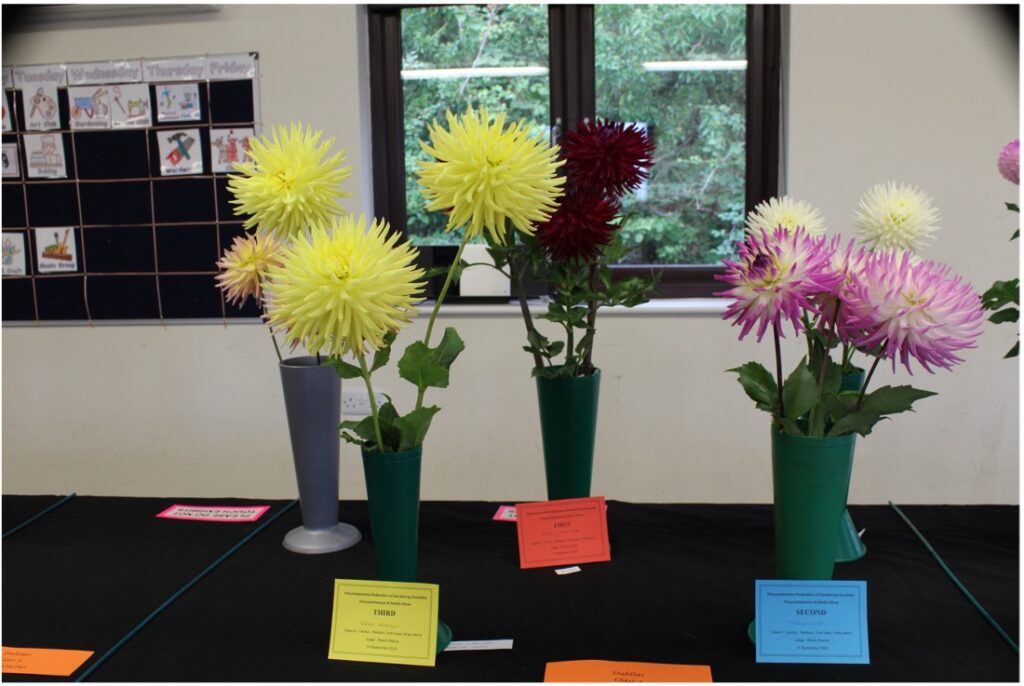
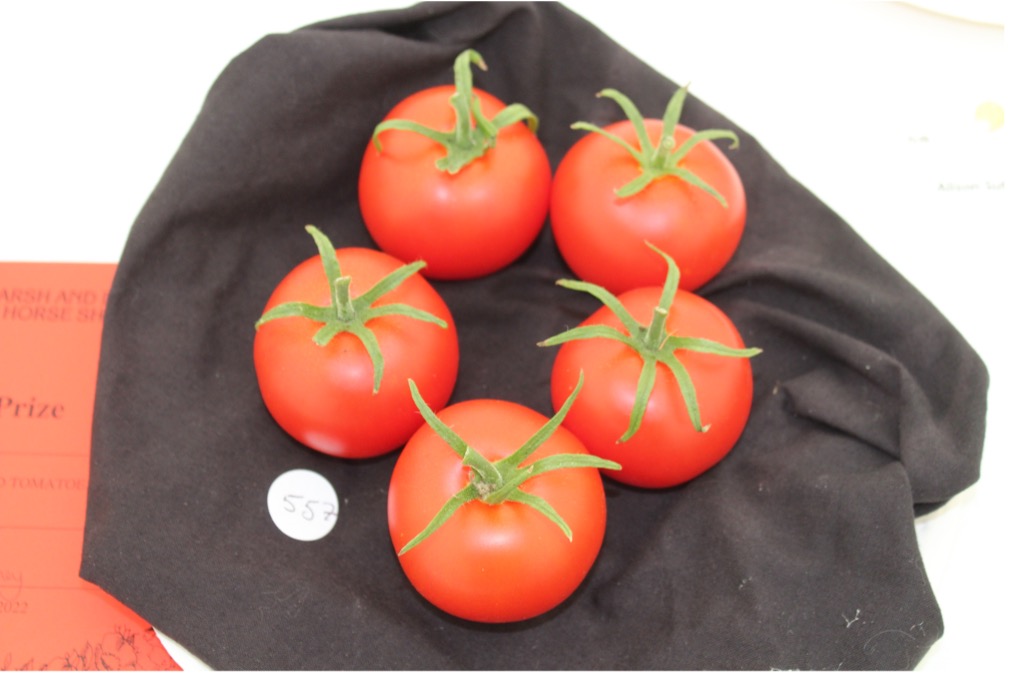
From simple, but sometimes forgotten, advice like reading a show schedule very carefully and making sure that exhibits are entered into the correct class, to the finer points of exhibiting, such as how many leaves to remove from a cabbage or which vase to use when showing your prize dahlia, Chris emphasised the importance of attention to detail, heeding guidelines and good presentation. He also had suggestions regarding which varieties of vegetables exhibit particularly well; useful to know if you have your heart set on a winner’s certificate.
Chris strongly advised referring to the RHS ‘Horticultural Show Handbook’ for hints and guidance on all aspects of ‘growing for showing’ as this is used by show judges.
As is often the case, however, the most valuable tips are not always to be found in handbooks and Chris gave us a great selection of those too: Remember that biggest is not always best and if it looks good enter it but bear in mind that judges can always tell if something is not home grown!
This was a very informative evening and hopefully will inspire members to have a go and enter our next Summer Show.
Our November talk attracted a good audience of members and guests to hear about the landscape and flora of Hokkaido , the most Northerly island and the second largest of Japan. It has coastlines on the Sea of Japan. the Sea of Okhotsk and the Pacific Ocean and is on the same latitude as Vladivostok. The centre is mountainous with volcanic plateaux.
The mystic of the country was brought to life by Nathalie Mignotte with wonderful slides of the ever changing landscape supported by her tales as a single intrepid traveller – having to participate in bear drill and hoping not to encounter one or preparing for long walks with hot matcha tea and a red bean pasty.
Known for its national parks the area has a volcanic legacy which has shaped a wilderness with low population density but peppered with hot springs, lakes, mountains, forests and patches of cultivated land . Warm summers are followed by harsh winters with many feet of snow whilst cold Arctic winds blow in from Siberia , each leaving their mark on the flora and fauna of the area.
During our tour with Nathalie we learned much about this fascinating area:
Each cultivated area is dedicated only to a single crop , be it rice or an orchard fruit such as plums and is concentrated inland – there is no mixed agriculture.
The national parks are well managed but not over managed to protect the natural landscape which takes priority over people . There is a huge respect for nature throughout Japan .So hot sulphur springs could be observed at close quarters without notices or barriers to warn the public and no one would ever pick any plant or flower out of its natural habitat. Locally growing indigenous bamboo or wood such as oak or birch are used to provide footpaths and to emphasise the natural look.
Tsunamis, typhoons and earthquakes occur which totally destroy vegetation and inform land management . A very acidic soil with brackish water provides the environment for dwarf azalea, rhododendron, grasses and bamboo under oak trees in the space of a mile . Enormous water lilies thrive despite enduring winter temperatures which freeze the lakes to a depth of three feet. Around every corner is a new vista whether mountain , blue lake or round black pumice stones .
The area is well known for moss and is the only place in the world where moss balls naturally occur in Lake Akan . Known as Marimo they are in fact a unique type of spherical algae, not moss , are protected as a declining species and symbolise everlasting love and luck.
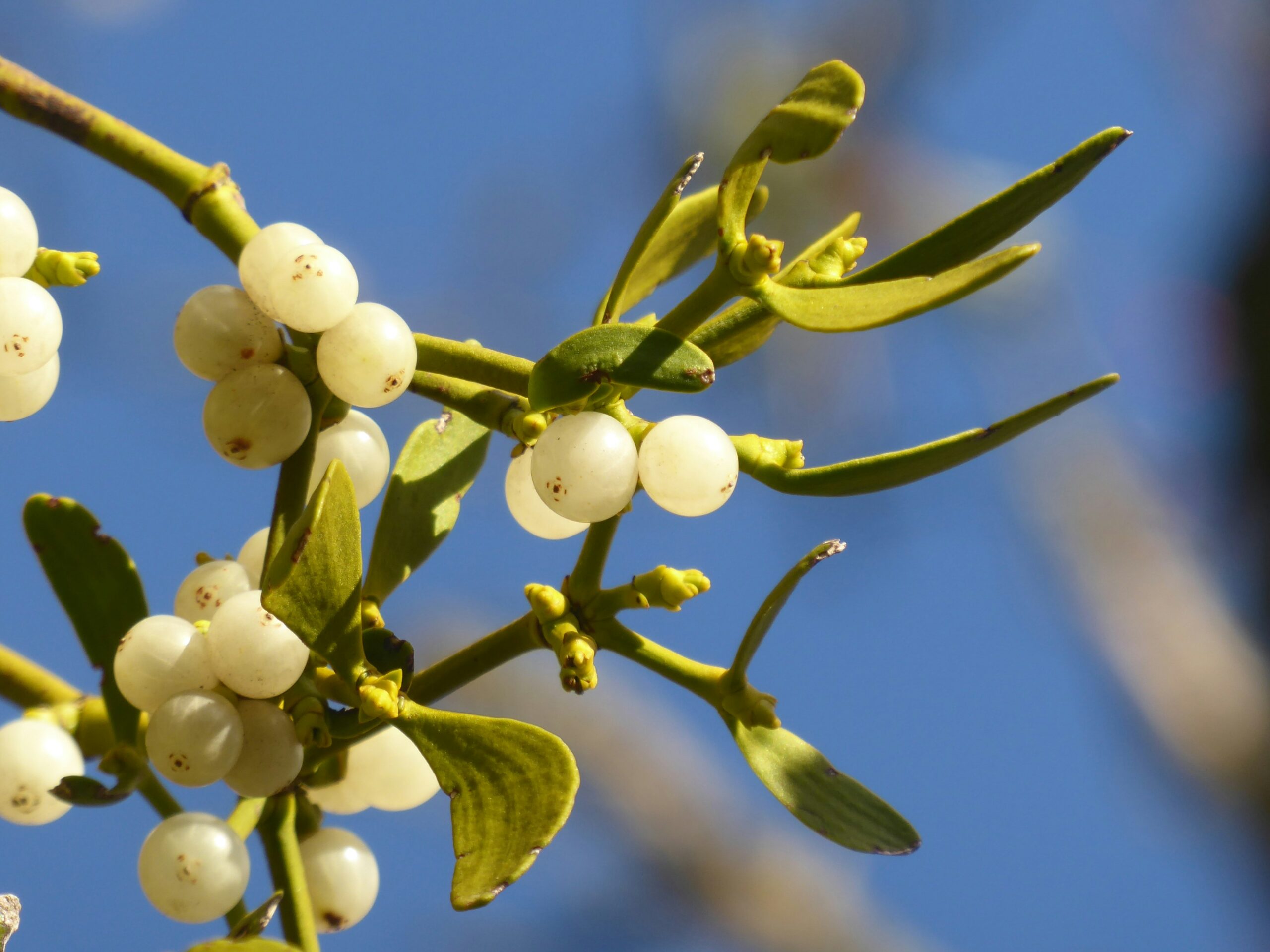
Mistletoe, fact, myth and legend was exactly what we were given by Dr Michael Jones, a popular returning speaker. Dr Jones was a lecturer in Botany at Newman University in Birmingham as well as spending three years in Africa studying Mistletoe. He continues to visit Africa each year to study the pollination of these plants.
Our talk was initially about the botany of Mistletoe and we learnt that there are two families of Mistletoe; 940 species of Loranthaceae (the showy ones) and 450 species of Viscaceae, 1390 in total. Recorded species include the smallest, which has berries larger than the plant itself, and the largest in Western Australia which looks like a tree.
The term Haustoriam was introduced next. A projection from the parasitic Mistletoe that anchors it to the host and then enables the Mistletoe to penetrate host tissues and absorb nutrients. The host is not killed but does suffer.
One thing that surprised many of us was that the Mistletoe we commonly associate with Christmas in the UK, namely Viscus album, grows only in the south of England, particularly around counties like Worcestershire and Herefordshire. Whilst happy with cold winters it likes an average July temperature of 16 degrees. Seeds are dispersed by the aptly named Mistletoe Thrush but also Blackcaps.
We learnt the ball shape (usually seen in apple trees) is formed through annual dichotomous branching and this allows the plant to gain maximum exposure to sun.
December 1st is National Mistletoe Day and in Tenbury Wells, the Mistletoe capital of England, various traditions take place.
Using Mistletoe is thought to originate from Saturnalia an ancient mid winter Roman festival, later becoming Christmas, when not much was available to decorate. Why do we kiss under the Mistletoe at Christmas? No one really knows but there are lots of associations of love and friendship, fertility and life due to fruiting in our winter and this English tradition became more popular under the Victorians.
Druids revered Mistletoe on oak trees and saw it as a cure all leading to All Heals Day (now All Hallows Day). Medicinal uses for Mistletoe include a complementary treatment for cancer and use as an anti inflammatory. However, Mistletoe is extremely toxic in high doses and contains Viscin, similar to Rycin which was used to kill the Russian Dissident in 1978. It is therefore mentioned in the Prevention and Suppression of Terrorism Act.
So overall we learnt much about Mistletoe but also how much is still yet to be learnt and through questions Dr Jones suggested there were many PHD topics still to be explored.
Richard Preston Subject: “Primrose Gardens, Steeple Aston”
An audience of 40+ members and guests braved a wet and blustery evening to attend the latest in our season of talks.
This time we were well entertained by a lively presentation by Richard Preston, who has superb comic timing and a great line in anecdotes.
Richard described the background to the establishment of Primrose Gardens in Steeple Aston. The gardens are a former walled kitchen garden, part of a much larger estate called The Grange, a large mansion which was sold for redevelopment. The grounds were also divided and sold, including the former Head Gardener’s “Primrose Cottage”. Richard’s grandfather Richard Wadham was Head Gardener for 40 years until 1939.
In the early 1950s the cottage and an acre of ground was purchased by Richard’s father, who developed the land as a vegetable-growing enterprise until 2001. During this time, produce from the garden were sold via the family van delivery service. Richard became fully involved with this, until a change of direction on retirement, when the story of the development of this acre of farmed land became today’s Primrose Gardens.
Richard and his wife Daphne have changed the plot beyond recognition using their own skills and imagination. This has been achieved with some help from, for example, their son-in-law who had an eye for the contents of a skip or two! Richard’s obvious negotiating skills also enabled him to find extraordinary garden features such as a terracotta warrior, an antique street lamp, a random sundial and much else to give the garden several points of focus.
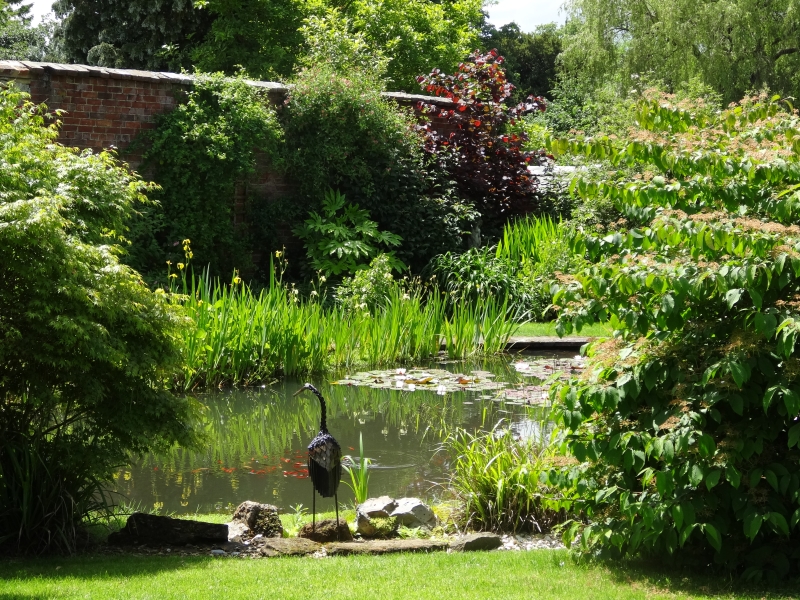
But it was Richard’s lively description of the past 20 years of development from what was an originally (possibly tongue in cheek?) idea of a low maintenance stretch of lawn with a few borders. It has now become a haven of flowers, shrubs, smaller trees, and an ever-decreasing amount of grass! A tour-de-force, amongst many, is a large pond created by Richard on what is a sandy loam and now looks like it has been there for ever.
Richard’s description of the changing face of the garden through the past 130 years, and his own involvement since the 1950s, was a true eye-opener. His talk was certainly an inspiration for us to think about visiting as a group before too long.
Those of us gardeners lucky enough to own a greenhouse are probably thinking of winter -proofing about now. I use mine for keeping cuttings in and storing tender container plants like Salvias, Cannas and Agapanthus. Maintaining the internal temperature above freezing is therefore crucial.
Time and enthusiasm permitting, the glass gets cleaned to maximise winter light levels, undesirables are evicted and the gubbins that collects over the summer is tidied up.
Heating a greenhouse in winter can be extremely expensive so I rely on low tech, ‘environmentally friendly’, solutions. I line the interior with bubble wrap and then install my heaters. These are two lidded black dustbins filled to the brim with water. These act as passive solar heaters keeping frost at bay. Another cheap solution which I have yet to try is to put grass cuttings in black bags which, as they rot down, release heat. Please let me know if this works. In very severe weather all the plants are covered with fleece for an extra layer of protection. I find it very important on milder days to open the doors to get some air movement to help prevent grey mould and fungal diseases.
It’s a well-known maxim that whatever size your greenhouse it’s never quite big enough, so extra storage solutions have to be found. Succulents, orchids and ferns which have holidayed outside during the summer are brought into the house to decorate windowsills. Sempervivens in containers which can tolerate cold but not cold and wet are put in the cold frame. Various non hardy summer bulbs such as Colocasia and Begonias are dried off and brought inside to store in the scullery. These are then promptly forgotten about and only rediscovered in the spring when green shoots appear from their brown paper bags.
Another autumn job, for me at least with a cold garden, involves lifting the dahlias after the first frost has blackened their foliage. I wash the tubers and dry them on a rack in the garage for a week or two by which time all the labels will have got mixed up! Each tuber is then wrapped in several layers of newspaper and packed into boxes which are stacked onto a table and draped with a blanket for winter warmth.
Roll on winter now with time to drool over seed catalogues and plan for next year.
Happy gardening
Nicky Pratt
The MUWAGA October talk is ‘Mistletoe – Fact, Myth, Legend?
For the first talk of the new season we welcomed a returning favourite speaker, Phillip Aubrey. Phillip is the former Director of the Oxford Botanic Garden and we were treated to a masterclass in the art (or science) of propagation in all its forms.
Seed and vegetative methods, including layering and grafting, were thoroughly explained, including the pros and cons of each, and all were illustrated with practical demonstrations. Phillip also shared his expertise on tried and tested tools, equipment and materials offering more tips and tricks than even Mary Berry could muster.
The session concluded with a selection of questions, comprehensively answered and there were plants for sale in addition to cards from original watercolours by Liz Aubrey.
For experienced and novice gardeners alike this was an informative, inspirational evening and gave a whole new meaning to the phrase ‘Go forth and multiply!’
We use cookies on our website to give you the most relevant experience by remembering your preferences and repeat visits. By clicking “Accept All”, you consent to the use of ALL the cookies. However, you may visit "Cookie Settings" to provide a controlled consent.
This website uses cookies to improve your experience while you navigate through the website. Out of these, the cookies that are categorized as necessary are stored on your browser as they are essential for the working of basic functionalities of the website. We also use third-party cookies that help us analyze and understand how you use this website. These cookies will be stored in your browser only with your consent. You also have the option to opt-out of these cookies. But opting out of some of these cookies may affect your browsing experience.
Necessary cookies are absolutely essential for the website to function properly. These cookies ensure basic functionalities and security features of the website, anonymously.
Cookie
Duration
Description
cookielawinfo-checkbox-analytics
11 months
This cookie is set by GDPR Cookie Consent plugin. The cookie is used to store the user consent for the cookies in the category "Analytics".
cookielawinfo-checkbox-functional
11 months
The cookie is set by GDPR cookie consent to record the user consent for the cookies in the category "Functional".
cookielawinfo-checkbox-necessary
11 months
This cookie is set by GDPR Cookie Consent plugin. The cookies is used to store the user consent for the cookies in the category "Necessary".
cookielawinfo-checkbox-others
11 months
This cookie is set by GDPR Cookie Consent plugin. The cookie is used to store the user consent for the cookies in the category "Other.
cookielawinfo-checkbox-performance
11 months
This cookie is set by GDPR Cookie Consent plugin. The cookie is used to store the user consent for the cookies in the category "Performance".
viewed_cookie_policy
11 months
The cookie is set by the GDPR Cookie Consent plugin and is used to store whether or not user has consented to the use of cookies. It does not store any personal data.
Functional cookies help to perform certain functionalities like sharing the content of the website on social media platforms, collect feedbacks, and other third-party features.
Performance cookies are used to understand and analyze the key performance indexes of the website which helps in delivering a better user experience for the visitors.
Analytical cookies are used to understand how visitors interact with the website. These cookies help provide information on metrics the number of visitors, bounce rate, traffic source, etc.
Advertisement cookies are used to provide visitors with relevant ads and marketing campaigns. These cookies track visitors across websites and collect information to provide customized ads.